From "Old Piano" for 2nd to "New Piano" for 3rd Millenium A.D.
Piano and it's #-Notation led western music through 2nd Millenium, founded in 11. Century by Guido v. Arezzo.

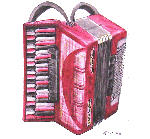
Here You see an Accordion with continiously chromatic Key Layout on the right hand Melody Side ("6+6 Accordion"). The rest of this Accordion (Bellows and Basses) is identical with a "common" Accordion.
Leonard Bernstein praised the combination of Chromaticism and the Circle of Fifths. Here we have an adequate instrument for his approach!
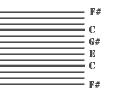
A Notation System without # and b displays the Sound exactly as it is played.
Button-Accordion (Bajan) provides the 12 Major and Minor Scales to be played on 3 Rows for the right hand, so that You only have to practice 3 Scales, the other scales work identically. But a melody runs in a serpentine in this system.
Piano-Accordion plays pretty Tunes in C Major / a Minor, but gets uncertain, when it leaves these scales. Bajan-Players seem to succeed better on creating nice sound carpets than semantic-tone-frequence-accented Melodies. Anyway, Bajan is superior to Piano-Accordion. Example: Vivaldi's "Summer on a Bajan and on a Piano-Accordion. Here are 2 more excellent Bajan-Performances, composed by Rimsky-Korsakov and J.S.Bach.


3-Row-Bajan-, 6+6- and Piano-Accordion

On a "6+6-Accordion" You play the 12 Scales with only 2 different patterns, depending on if the Scale's Base Key lies on the Upper or Lower Row. What miracles can we expect from Virtuosi on this optimal Accordion!
Serial Production of this Instrument would be easy: We only need 2 CAD-Models of the flat moulds instead of 6 as for the piano. Octave-Distance gets shorter, so that we can fit more than 4 Octaves on the space of formerly three and a half. This meets Classical Music Standards! The costs for machine preparation to build a serial model of a 6+6-Set will pay very shortly.
It should have axis mounted keys that connect to a new 6+6 melody wrestplank, to be mounted into the original accordeons chassis.

"Professional" Piano Players will miss their Scale-Unbalance.
Unprejudiced People will love this Instrument because of the fact that each Interval in any Scale is played with identical finger patterns, which leads to much faster Practicing Progress than Piano-Accordion-Practicing. An Englishman played Beethovens Mondscheinsonate around 1950 on a 6+6-Piano, as british Author James G. Ballard reported in his Autobiography . (After he died in 2009, Diana Rigg alias Emma Peel might solve the case of this unknown artist from the Midlands. Dame Diana Rigg spent her Teenage in this area.)